


If you haven’t checked out the beginning of this evolving story, feel free to do so prior to reading Chapter 4! Here is the Prologue, Chapter 1: Falcon, Chapter 2: Ghost Town, and Chapter 3: Onward!
Star’s mud puddle dries under the white-hot sun, making it harder for the lonesome desert girl to escape her ruined oasis. But the falcon isn’t worried about her. He’s focused on the broken window, the one he’d noticed earlier on the far side of the barn. He’s still hungry, curious if there are more mice within the massive dilapidated building. He lifts off, swoops around back, leaving his waterlogged comrade alone as she strains to pull herself from the thick muck. As Star watches the bird fly away in a flash of grey and brown, she believes him gone forever. She’s been abandoned yet again, worrying her parents have done the same. She feels a shameful urge to cry, but as tears press against the insides of her burnt eyelids, she defers to the words jotted in her parcel — Bird on the horizon, sittin’ on a fence / He’s singin’ his song for me — as if they’ve become her newfound mantra.
The girl’s low voice — a dim rhythmic croak — fades under the swell of the desert breeze as the falcon glides into the barn, grazing the outer edge of his left wing on a shard of broken glass. The frenzy of mice scurrying along the structure’s second-story catwalk don’t notice him. Without much effort, he grabs two smaller rodents, snatching them off the floorboards with a single talon. Coasting over a long wooden railing with his feast, he thinks of his master, loafing around their house, the last two cans on a six pack dangling from his middle finger. The falcon nose-dives toward the middle of the barn floor, landing on the enormous field of dirt, dappled by rays of light streaming through gaps and holes in the barn’s wooden exterior. There are hundreds of mice. Tiny shadows weaving in and out of the barn’s nooks and crannies. They’re running for their lives.
To the falcon’s surprise, there are just as many oil paintings in the barn as there are vermin. Large and small. Framed and unframed. They hang on metal hooks nailed into a maze of sturdy crossbeams. At first, the falcon is amused by his discovery. He swallows his two captives whole — the second creature’s pinkish tail disappearing like a buttered noodle between the bird’s yellow beak — and gazes at the art: dinner and a show. Tilting his head back, he is struck by a mural painted across the barn’s lofted ceiling. A blood red explosion entombing the tortured faces of demons, devils, and multi-horned monsters. Evil-eyed birds swarm and peck at the flesh of human babies and sacrificial lambs. The falcon is offended. This menacing portrayal of his avian race forces the bird to let out a loud raspy caw.
Star hears the sound of the bird’s haunting screech. Her mantra quiets to a whisper. Knowing the bird hasn’t left Ghost Town, the girl’s chapped lips form a crooked smile. She finally frees herself from the depths of her mud bath and shakes off the heavy mud caked to the backs of her thighs, clambering toward the barn. Star plants her feet and tries to slide the heavy wooden door along its rusted steel tracks. She hates the barn. Whenever possible, she avoids this place. Especially if her father is inside painting. Through the pine boards, she’s heard noises a dying animal would make — not unlike the falcon’s screech — as if her father were possessed by the very devils threatening his artworks. He has been known to return to the house for dinner, his clothes and skin flecked with blood-red paint. But Star can see the bird in her mind’s eye, all alone, and her tired body won’t stop pulling at the splintered door, eventually forcing it open.
She stands at the threshold with the bright sun at her back. The desert girl admires her elongated silhouette, which overtakes the dusty expanse of the barn floor. She marvels at its size. How perfectly it frames the falcon, whose yellow feet stand on her shadow’s heart. He’s turned away, engrossed in the breadth of her father’s life’s work.
The bird can appreciate the artist’s talent. His ability to translate horrific biblical images into these bizarre, dreamlike renderings of the end of the world; it is impressive. Yet, the fact that anyone would use their creativity to construct this — this hell-house on the far edge of Death Valley — makes the bird squeamish, as if one of the mice he’d devoured had ingested a poison trap. He’s known many men, but none as well as his master, and he can’t help but compare, relating the surrounding serpents, the fire and brimstone, the plagues, earthquakes, sorcerers and ripped flesh — all of it put to canvas in dark red hues — to a poster he adores. A poster featuring a much cheerier shade of red. Set behind glass with a white bird balanced on the neck of a brilliant green and blue guitar: An Aquarian Exposition, 3 Days Of Peace & Music, it reads. The falcon feels a sudden urge to lift off and return to that image, as if it could magically cleanse him of this moment, this putrid, fascinating scene. He’s sure it’s still hanging in his master’s bedroom, the poster, centered in its ivory frame above the king-sized water bed.
While the bird considers taking flight, the barn door, as if spring-loaded, slides back on its tracks and slams behind Star. She jumps. The falcon’s head rotates on a swivel. He watches a flower of fear bloom in the desert girl’s eyes as her sun shadow melds into the surrounding darkness. The bird can see now that some of the holes and gaps in the barn’s paint-chipped exterior are carved by hand. Natural spotlights directing differently-sized sun streaks toward the largest of the paintings. He studies a low-hanging triptych to his left that glows in an angelic laser beam. A ball of fire floats in space, its cracked red surface birthing a heavenward ladder snapped in half beside a rejuvenated rendering of Ghost Town. The painting is marked #575. Its muddy red landscape shimmers like a bowl of cherries rotting in the sun.
A Bible verse stretches across all three panels:
𝕬𝖓𝖉 𝕴 𝖘𝖆𝖜 𝖆 𝖓𝖊𝖜 𝖍𝖊𝖆𝖛𝖊𝖓 𝖆𝖓𝖉 𝖆 𝖓𝖊𝖜 𝖊𝖆𝖗𝖙𝖍: 𝖋𝖔𝖗 𝖙𝖍𝖊 𝖋𝖎𝖗𝖘𝖙 𝖍𝖊𝖆𝖛𝖊𝖓 𝖆𝖓𝖉 𝖙𝖍𝖊 𝖋𝖎𝖗𝖘𝖙 𝖊𝖆𝖗𝖙𝖍 𝖆𝖗𝖊 𝖕𝖆𝖘𝖘𝖊𝖉 𝖆𝖜𝖆𝖞.
There’s an order here, the falcon decides. An evolving tale. A story about being saved.
Star follows the falcon’s sightline as it drifts from painting to painting, finally landing on her father’s largest, and, in her opinion, his most troubling creation. The final number in the series. A family portrait. Which rests on the giant metal easel her mother had constructed a few years back, when Paul’s canvases became too large for the old wooden mount.
The number 666 is stamped at the top of the canvas, just above a man the falcon believes to be the artist, a man whose features — wide mouth, dimpled chin, jutting ears, and flared nostrils — oddly resemble his master’s. It’s uncanny, the congruence. Even considering the obvious differences. The man in the painting is much thinner, and his eyes — two dark stones — in no way remind the falcon of his master’s glassy, blue-grey gaze, which sparkles with a mischievous threat of fun. This painted figure is balding, his face shaved smooth, unlike his master, whose ruddy mane hangs over his shoulder in a loose braid, and whose thin upper lip remains buried beneath a dense mustache pinched with grease. The bird turns his head again toward the girl. She stands dead-still behind him, like petrified wood, her mouth ajar. Her slanted nose and straw-colored mop look almost identical to her painted persona, standing to the artist’s right, with an older silver-haired woman — likely her mother — off to his left. All of them appear to be naked, though their bodies end just below their collar bones. The center of the canvas is blank.
In a daze, Star steps toward the bird until they’re side by side. She forces herself to look at the painting. The falcon doesn’t move.
“It’s not finished,” she says aloud, as if trying to convince herself of the unstoppable rotations of Earth.
The falcon picks at his neck feathers with the end of his beak.
Star’s voice deepens and becomes strained: “We won’t achieve our full forms until the reckoning has passed.”
The falcon refocuses on the portrait and the white space where their bodies should be. Rivulets of red paint glisten and run down the canvas.
Time passes as the two of them stand in the dark, studying the unfinished portrait. Number 666. Tracing the pale red lines to the very bottom of the canvas where it says:
𝕿𝖍𝖊 𝖔𝖓𝖊 𝖜𝖍𝖔 𝖌𝖚𝖆𝖗𝖆𝖓𝖙𝖊𝖊𝖘 𝖙𝖍𝖊𝖘𝖊 𝖗𝖊𝖛𝖊𝖑𝖆𝖙𝖎𝖔𝖓𝖘 𝖗𝖊𝖕𝖊𝖆𝖙𝖘 𝖍𝖎𝖘 𝖕𝖗𝖔𝖒𝖎𝖘𝖊: 𝕴 𝖘𝖍𝖆𝖑𝖑 𝖎𝖓𝖉𝖊𝖊𝖉 𝖇𝖊 𝖜𝖎𝖙𝖍 𝖞𝖔𝖚 𝖘𝖔𝖔𝖓.
The falcon has seen portraits before, but they look different on the walls of his master’s home. Sharper, more realistic. With plenty of color used to capture the same people who regularly float in and out of the house. But when they’re out. Sweat-streaked on stage. Mouths pressed to guitar strings. Giving the finger from the back of a smoky bus. Balanced atop an amplifier. Crushing a can of beer. The portraits the falcon’s master collects depict distinct personalities and joyous memories. Not a predicted future, but a cherished past. Most subjects look right at you, too, not off to the side, like the desert girl and her parents. What exactly are they staring at?
“It’s the promised land,” Star says. “The land my father says is promised to us after the world begins to burn.”
The falcon lets out a half-screech and flaps his wings. In a flash, the bird’s yellow toes are spread wide over the slope of Star’s left shoulder. The sharp ends of its arched talons just barely dig into her damp skin as dust particles drift through the thin beams of sunlight. The falcon’s presence on Star’s shoulder is comforting to her, natural. The bird, locked into place, wears the same stern, clear-eyed expression that all falcons possess, but the side of his feather-soft head bumps up against Star’s earlobe like a pet. He is the desert girl’s first-ever visitor out here in the Big Sink. He has seen the bloody center of her life and he has not flown back to where he came from. Star feels as though the falcon has chosen her, and because of that, she now trusts this uninvited bird of prey.
“Do you have a name?” Star asks the falcon, looking down at the top of its dark feathered head.
The falcon doesn’t respond.
Star realizes she hasn’t let go of the parcel, which has become ruined in her grip by sweat and mud and heat. The smooth leather case is still intact, but the sheet of onion paper within has begun to disintegrate, leaving the remaining message smudged and illegible. It’s okay, Star thinks. The words are etched into the walls of her mind, like the petroglyphs she’s seen on Scavenger Hunts, carved and painted in hidden desert canyons. Ancient lines. Faceless figures. Big horned elk. Wild horses with long white necks. Sometimes she imagines reality through this lens. A lone bird — a falcon — and a long-haired girl. Arms spread, kneeling beneath a broad-shouldered being shaped by a frenzy of teardrops. Music notes fall from the granite sky. She doesn’t know what this means, but she can see it clearly when she closes her eyes.
Ever since the parcel dropped into Ghost Town, Star has not let the written stanzas leave her lips. Like the people who walked this land thousands of years ago, she seeks meaning in the great unknown. Through every spoken repetition, the lonesome desert girl unfurls an internal tapestry marked by melody, rhythm and sound. She’s closing in on something she already holds dear. She begins to sing the words like they were meant to be sung, the way they sounded in the head of the famous man with two first names, who wrote furiously in his pocket-sized journal while dreaming of blood on the tracks. For over half a century, the whole world has heard this song. And just like Star, they have felt a kinship to it, as if the words were written just for them.
The falcon, who knows Bob Dylan personally — he’s sung his tune once or twice in the bird’s presence — prefers the sound of the desert girl’s voice, the way it shamelessly explodes from her chest, echoing through the barn’s bleak hellishness, overpowering the haunted space with a plea for life. With clenched fists and parted lips, Star’s body leans way back on its soggy heals. Watching her make Bob’s song her own inspires the falcon to join in, which he almost never does. But he wails his own hoarse cry into the hollow belly of the barn, harmonizing with Star. Together, they spawn a screeching roar that ricochets off the hand-carved frames and the dulled horns of devils and the razor sharp edges of broken glass. Their voices soar out into the sizzling heat, glide high over the Black Mountain Range, over Coffin Peak, and through miles of endless unforgiving desert.
When they stop singing, the space is quiet, except for the wind gusts shaking the metal roof. Star, who had shut her eyes, wanted the paintings to evaporate, the cracks and holes in the barn’s facade to have splintered and split, collapsing the walls around her. But it’s all still here; the darkness, the dust, and her father’s unfortunate pursuit. For the first time in her life, Star feels like she’ll actually leave Ghost Town, on her own terms. Especially if her parents have already gone. There’s nothing left to keep the girl tethered to this forgotten wasteland.
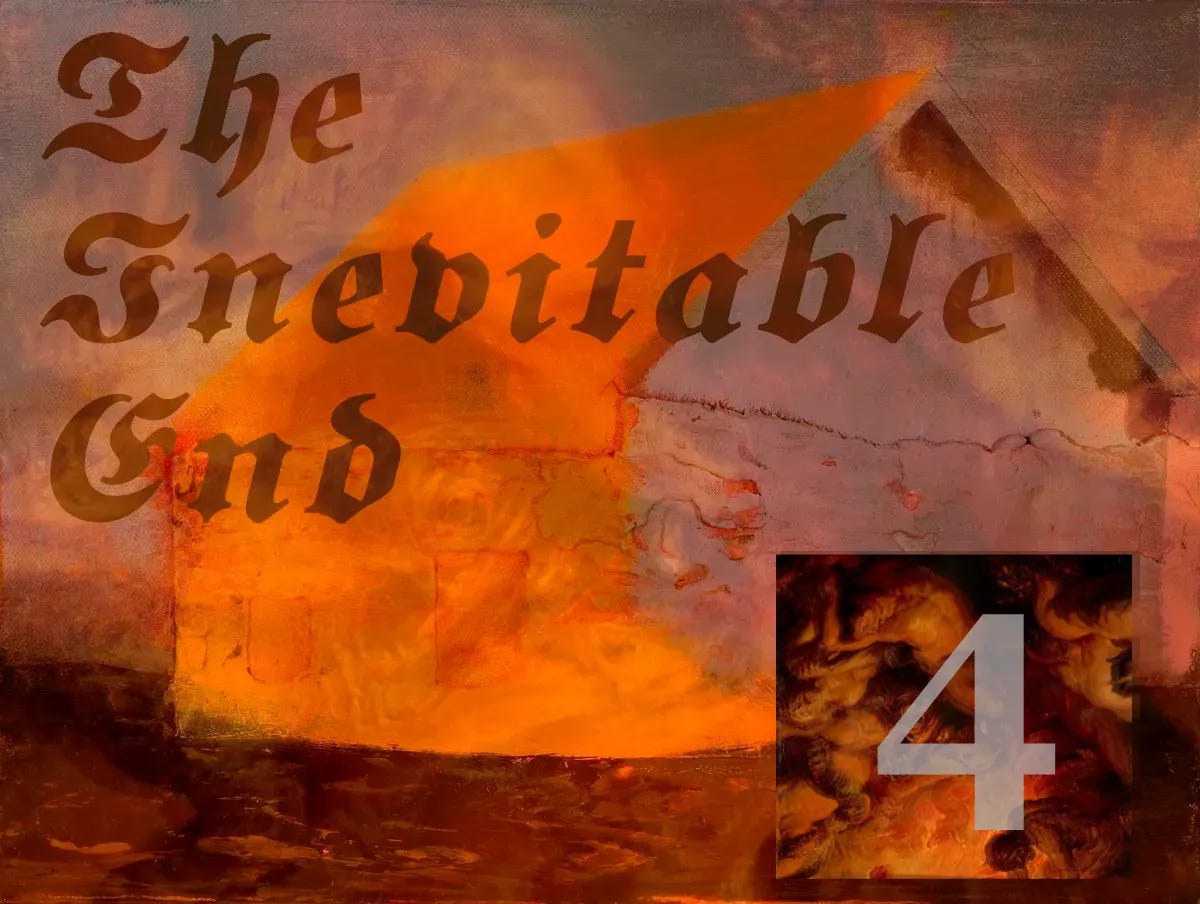
The falcon is still perched on Star’s shoulder. In unison, they stare up at the ceiling, at the blood-red explosion of devils and beasts, and they read the title of Paul’s series of pantings, as if it were printed on the window of an urban art gallery. A message spelled out above the hellish mural in buckets of night-black paint:
𝔗𝔥𝔢 ℑ𝔫𝔢𝔳𝔦𝔱𝔞𝔟𝔩𝔢 𝔈𝔫𝔡
“I think I’ll call you Trip,” Star says, still staring at the giant gothic lettering.
The falcon doesn’t respond. He doesn’t care what he’s called; he’s had so many names over the years and most of them have made no impact on him. He just wants the lonely desert girl to know that nothing is final. Everything continues. True stories are like time, he thinks. They never truly end.