


If you haven’t checked out the beginning of this evolving story, feel free to do so prior to reading Chapter 2! Here is the Prologue and Chapter 1: Falcon. Enjoy!
August 8, 1971. Dawn.
The bank teller, a girl just a few years older than Paul, stood at the front desk behind a faded sheet of glass. Her hair was cut like a boy’s. Choppy, above the ears, jet black like the polished beak of a crow. Her head was tilted to the side while her hands moved frantically below the counter. Paul watched as the girl’s thin oatmeal-colored turtleneck took on the same olive shade of her skin then disappeared, revealing a foggy outline of her naked body.
He glanced around the cavernous bank. It was empty, save for him and the teller, whose moans now echoed off the towering sandstone ceilings. They grew louder as he crept closer. Sweat poured from his palms. He had a vice grip on a single paper check, which was now soaked. When he tried to blow it dry, the paper flew from his fingers, drifted across the room, and disappeared from view.
The teller’s left hand rose from below the counter like a deep-sea diver coming up for air. It landed with a thud against the window. Her fingers spread wide and slid against the glass, wiping an arched streak through the haze, exposing her bare chest.
Out of learned decency and the lingering embarrassment of puberty, Paul tried not to look, discreetly tucking his hard-on up into the waist of his jeans. Still, his feet were a runaway train, braking only when his face pressed against the window, his sightline landing just above the pale pink edges of the teller’s nipples. Slightly higher up, another streak appeared in the glass and a pair of mossy green eyes stared back at him. Eyes Paul knew intimately. Eyes he’d become obsessed with in his waking life, ever since the switch flipped on the opposite sex and girls became more than just an inconvenience; when women and their bodies began to overwhelm his daily thoughts, that’s when Paul had first noticed her eyes — two patches of dark dewy grass now beckoning him to remove all barriers. To smash the window. To tear it down. Whatever it took to bring them together. So their limbs could tangle and pull one another to the cool stone floor.
Paul seized the pane of glass with both hands and started to yank, but the weight of the Good Book — the sound of the family Bible booming against the living room floor — ripped him from his dream.
“Let’s go, let’s fucking go!” Roddy, Paul’s younger brother, began screaming at him from down the hall, bursting into the small bedroom. “This shit’s coming down!”
But Paul, in the safety of his quilt, was too wet and too startled to register his brother’s panic. As the room shook, the memory of Bella’s eyes hung heavy in Paul’s mind. He was too distracted by the intensity of his dream to see his boots, the black ones capped with steel, fly across the room like a fired bullet. They clipped him right above the left eyebrow. In a daze, he pressed his finger to his temple, checking for blood. Roddy hurled the rest of his brother’s wardrobe — a sweat-stained Ford tee with a frayed orange collar; thick denim overalls bleached white from shifts at the borax mine; and a sweat-stained trucker cap. The curved brim spun full-speed into the ridge of Paul’s slanted nose.
“Jesus Christ!”
Roddy’s eyes narrowed. His older brother’s motionlessness irked him. It was classic Paul, disassociating at the worst possible time, unwilling to act. Roddy took a breath, and without speaking, he held out his hands, palm-side up, like a scruffy teenaged God. As if to say, Look around, Bud, you’re gonna die.
The bedside lamp crashed against the floor, its lightbulb shattering into a dozen tiny shards. The bookshelf fell face down, spewing books and trinkets across the rug, which their mother had woven when she was still pregnant with Roddy. Paul remembers watching her hands through the slats on his crib as they blended spools of color with two long needles. The memory brought on a surge of calm. Some children see their cribs as prisons and stumble through routine jailbreaks. But Paul stayed put. He liked when the world was small, when he was confined to a four-by-two space guarded by an angel called Mom. Perhaps that was the first major difference between him and Roddy. Prior to his younger brother’s curly blonde mullet, a hatred for school, and an obsession with rock n’ roll — before all that, it was clear that Roddy would never stay put. Paul was powerless to the sinking lure of the past, but Roddy was planning his next move, planning his escape.
A crack began to snake across the bedroom ceiling, dropping little chunks of plaster on Paul and his quilt. The significance of the moment finally hit him.
“Roddy!” Paul yelled, but his brother turned and dashed down the hallway.
Paul ripped off his quilt and jumped from his bed. He slid his overalls on over his soiled underwear and searched for his other boot. It was wedged between his mattress and the wall. He had two identical holes in the heels of his alpaca wool socks. As he pulled at the boot, the floorboards trembled against the skin of his partially exposed feet and sent him somewhere else — propped up on the back of a horse for the very first time. No saddle, no reins. He remembers staring down a newly-formed bald spot at the crown of his father’s misshapen scalp. Wrapping his small hairless arms around the beast’s giant neck. His father loading up his long arm like a shotgun. The old man was seconds away from smacking the horse’s ass as hard as he physically could and Paul knew he’d have no control over the animal once his father made contact. The bucking animal would bolt to the horizon in an all-out sprint. Paul held on as best he could. “Don’t fall,” his father had muttered, winding up.
Haunted by the echo of that first ride, Paul knew this earthquake could become a bronco just as wild. Bucking, unbroken, driven to chaos, capable of anything.
As he stumbled from the bedroom, still trying to latch the left strap of his overalls, the shaking grew more violent. He struggled to stay upright. The single light fixture responsible for illuminating the dark hallway swung on a pendulum. Sparks flickered from inside its pink circular orb and showered Paul, covering the back of his neck like a nest of hungry fire ants. He gripped the walls for balance and screamed out for Roddy but couldn’t hear his own voice over the deafening rumble of nature; it was as if a freight train were barreling straight through their home.
The roof had begun to slide, but Paul didn’t notice until dawn’s orange glow crept through the living room and kitchen, casting long heavenly shadows over a graveyard of the Bellamys’ former life. Paul could see the front door, it was wide open. Beckoning him to follow his brother to safety. He froze. The damage was addicting. His father’s deep-seated rocking chair — where the old man snoozed for a few hours after overnight shifts at the mine — was split in two by a long slab of sandstone that must have dislodged from the top of the chimney and fallen to the earth like a Looney Tunes anvil. His mother’s artwork — paintings housed in frames Dad had fashioned from desert driftwood — lay scattered across the floor. Behind some broken glass, Paul recognized the wide strokes of a yellowish superbloom his mother had sought to capture each autumn, wheeling her easel and brushes out to the desert in a rusted wheelbarrow. The disaster’s forewarning — the family Bible — was there too. It was wide open, spotlit by the rising sun. Despite the quake’s menacing roar, Paul crouched down and picked up the massive book. He was comforted by how the worn leather felt in his hands, unfairly annoyed that it had interrupted his dream. He read aloud what it said at the top of the page. Revelation, Babylon has fallen.
At this point, the roof, which was old and slightly angled, had fully slid from its anchors, crashing into the back bedrooms like an ocean wave made of asphalt. The Bellamy home, or what was left of it, now had the world’s largest skylight. The blinding glow of morning forced Paul to look up and take in the view. The sky had never looked so out of place, so invasive. It was magnificent. The endless tapestry of color, brilliant oranges and yellows. Transfixed by the fiery glow, Paul was stunned by something he could not yet name. He was stuck in a moment that would forever alter his path. A brief period of time that would sink its fangs into the boy and inform every decision he would come to make. Refusing to let go. Until a pair of strong hands seized his shoulders and yanked him backwards, dragging Paul’s useless body through the front door.
Paul was laid out in the dirt yard, rising up on elbows just in time to watch his childhood home collapse into a thick cloud of smoke and dust. The stucco walls caved like a house of cards. At this point, the shaking had stopped. Roddy coughed and spat at the ground. He was bent over his older brother, panting like a rabid dog —“Paul. You’re a fucking liability.”
Paul was in shock. “Dad wasn’t in his chair…”
“He’s probably still at work,” Roddy said, hacking a wad of phlegm into the dirt. A quake strong enough to bring down the house was sure to have done some serious damage at the mines. As the dust settled around them, Roddy tried not to picture the working men being thrown from the steep rock terraces carved into the canyon. Their father was a tough old bastard, and Roddy had inherited his grit, but despite what he may have told them growing up, he wasn’t indestructible. And, to his deepest dismay, neither was Roddy.
Paul was still clenching the Bible in his right hand. His middle finger was wedged inside, marking the page that faced him inside the now non-existent house. With some courage, he would delve into Revelations later — a portion of the Good Book that always frightened him in church as a child. He held the leather-bound book tight to his chest. Aside from the clothes on his back, this was his one remaining possession.
Screams ricocheted through the neighborhood.
About 50 yards to the East, the facade of the Fust’s three story townhouse hit the ground with a soft thud, kicking up a dust cloud that blew through the brothers’ hair and cloaked a small pile of vinyl records in dirt — the only items Roddy had rescued from the house, along with his portable red and gray Phillips turntable.
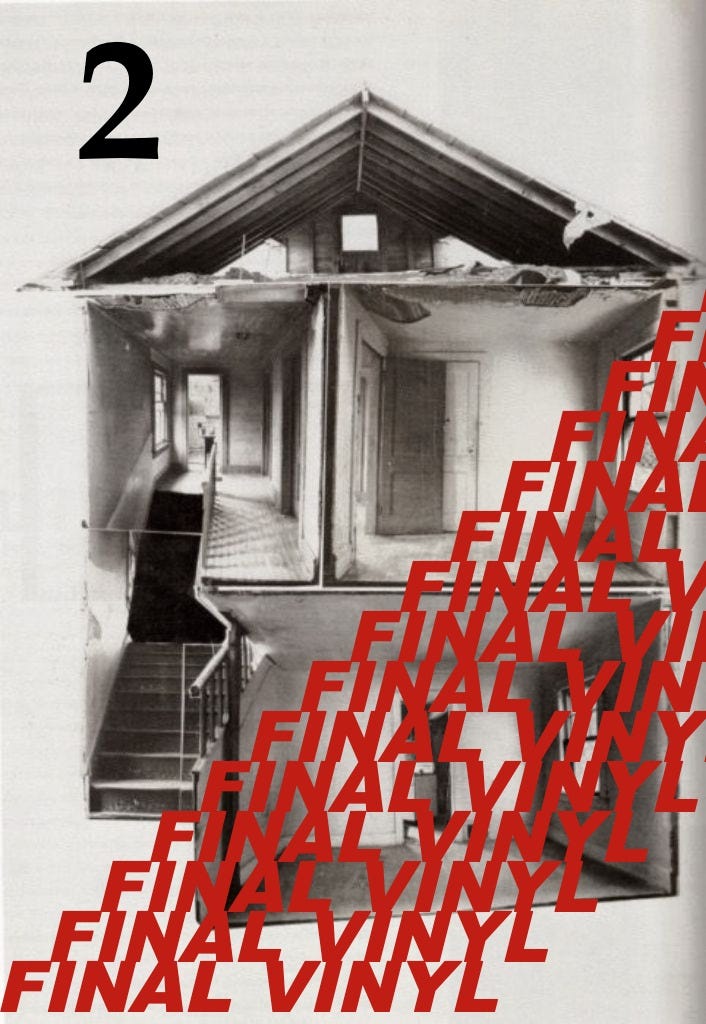
Together, with their belongings, the boys turned their heads in unison to look back at their next door neighbors’ home. The Fusts were known for throwing Sunday potlucks after church. All that remained was a life size dollhouse, its interior rooms perfectly exposed.
“Happy birthday, brother,” Roddy said, choking on the air. “Hate to say it, but 18 might be a strange one.”
Paul said nothing. He was still scanning the rooms, looking for Bella — the bank teller, Bella Fust — but she, nor her family, was anywhere to be seen. He closed his eyes, lay back in the dirt, and cried.
“Come on,” Roddy said. “Let’s go find Dad.”