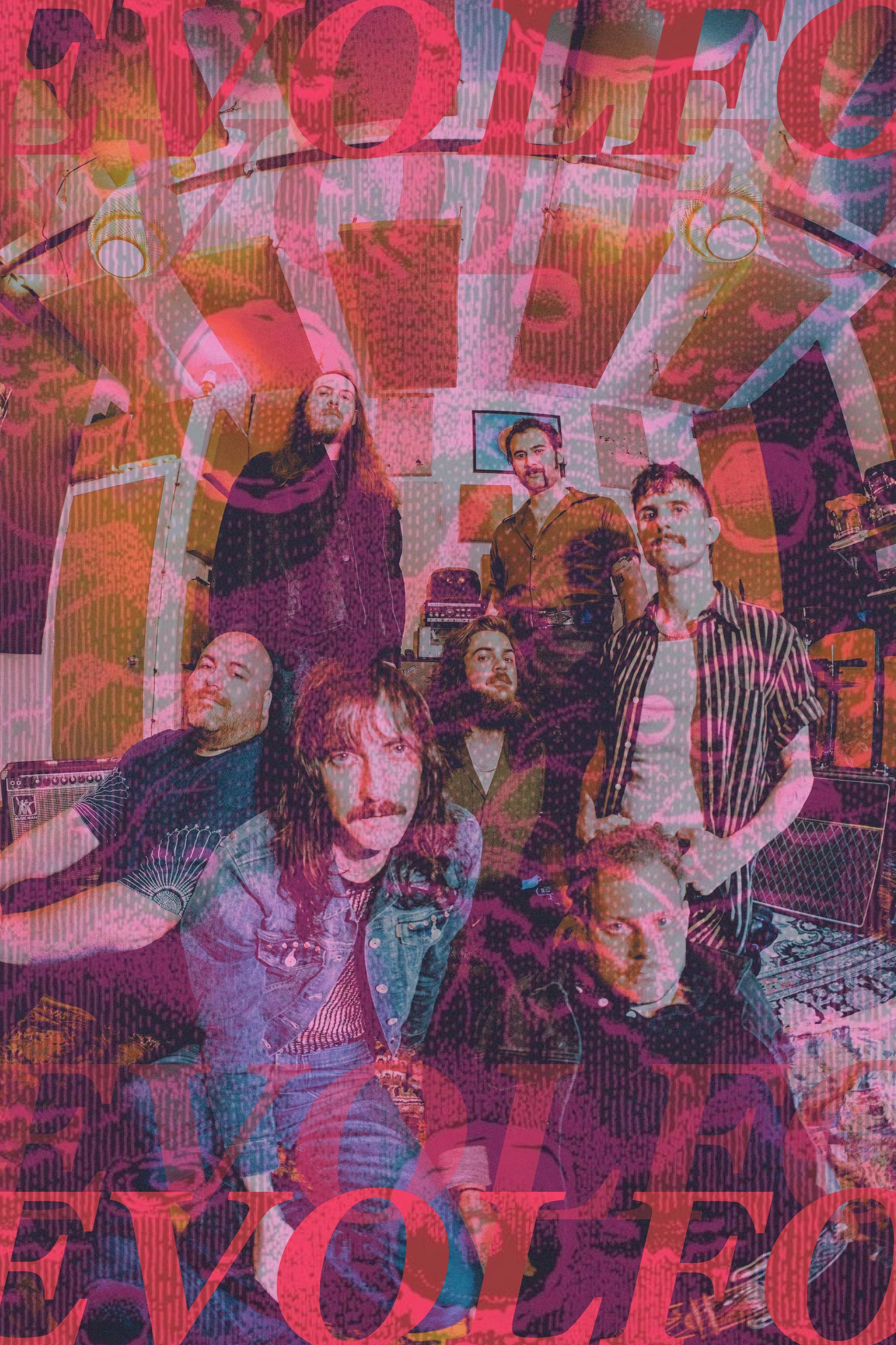
Cities built of silver hives and chrome buildings. Foam-sprayed oceansides where sand swirls and love blooms upon a wet stone. Pitch-black coal mines brimming with bright yellow songbirds. The backseat of a moving car, heat-scorched, home to a boy lost to time. Acid rain igniting a restless seed. A gleaming mutt with lead paws spitting fire through the bars of its cage.
These elastic worlds, distorted by vivid imagery and lingering questions, encapsulate the mind-bending magic of Evolfo’s newest record, Of Love. A dazzling series of disorienting quests that ebb and flow through liminal spaces, limbos, memories, and in-betweens. Places where questions are more useful than answers, where diving deeper delivers an inner freedom, a state in which we can “draw ourselves anew.”
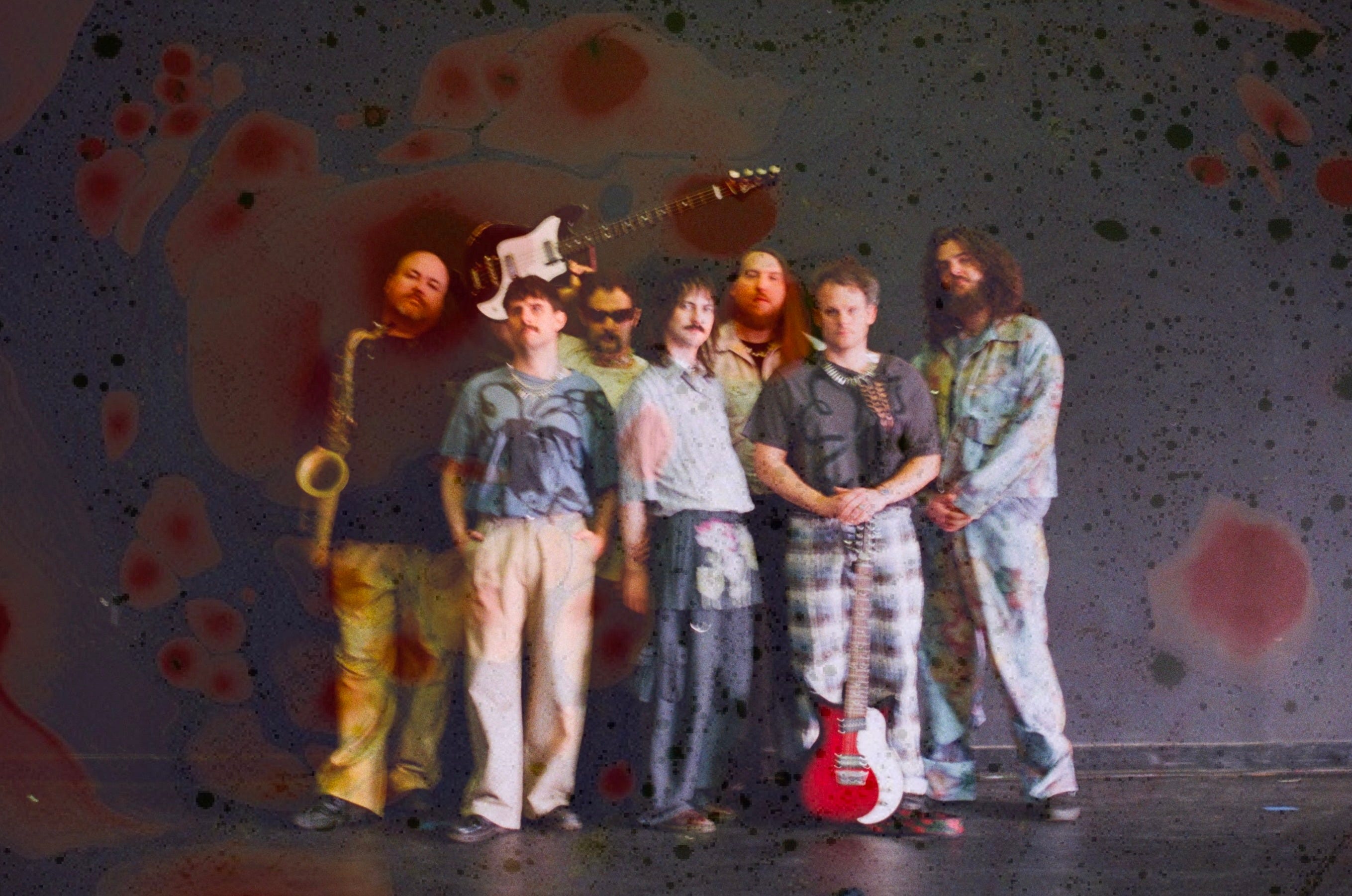
Since speaking with the Brooklyn psych-rock ensemble, I’ve seen their third album as a paradox.
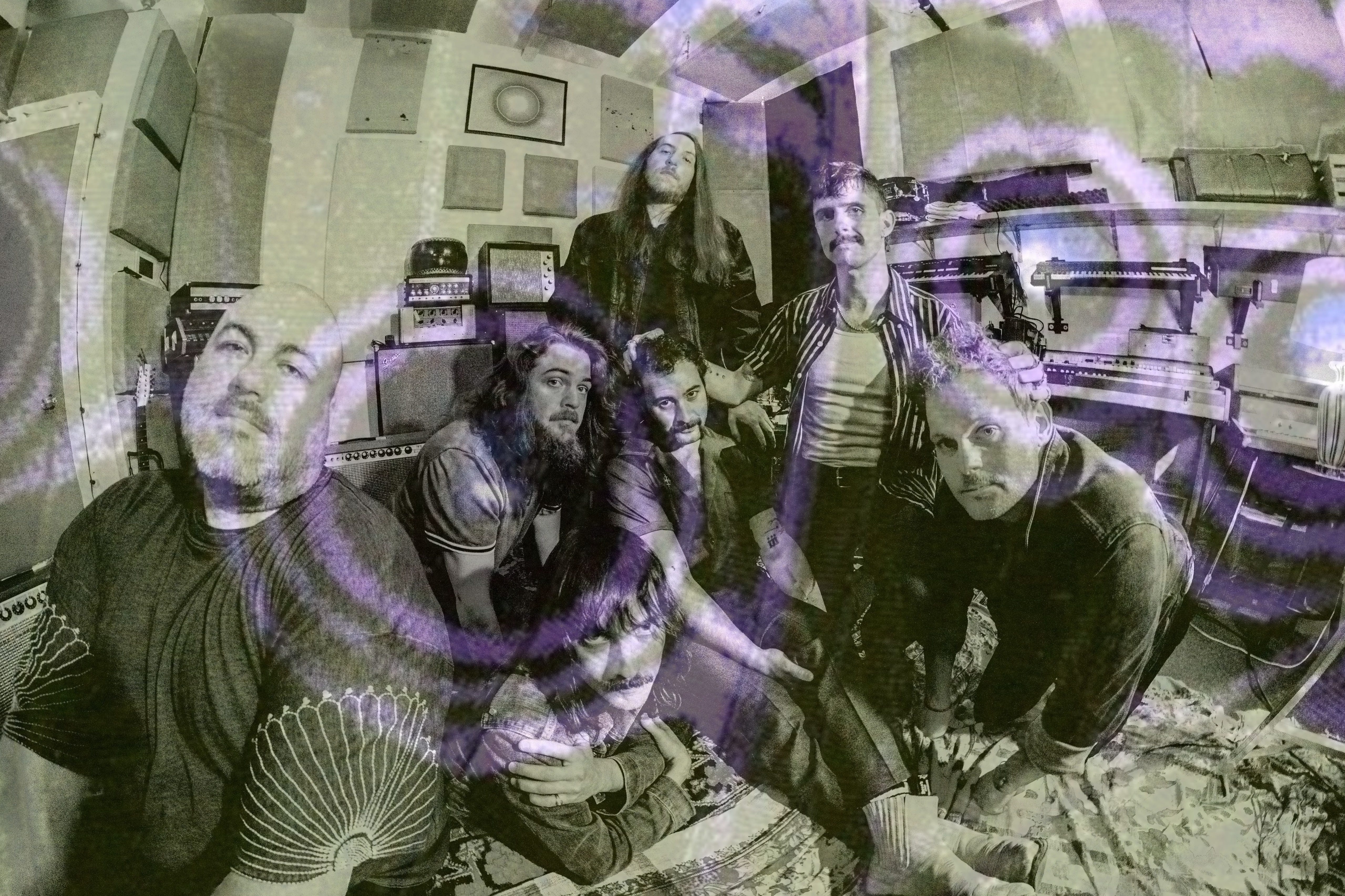
To manifest the expansive worlds living within Of Love’s grooves, all seven members of Evolfo set out to transform and found a physical space — Sound Home — where they could make a record outside the confines of forced rehearsal, paying by the hour, and worrying about an attic roof collapsing in the midst of a fruitful session.
Of Love was created within the sound-proofed walls of a newfound home-base, an ideal environment for practicing, recording, and communing in the midst of a global pandemic.
Unbeknownst to the band, three years of free-wheeling meet-ups at Sound Home would eventually produce the nuts and bolts of not only their most expansive, genre-defying record to date, but also mark the exigence of their new independent label, Food Of Love Records.
From the blue-lit corner couch of their studio, facing a wall of keyboards, synthesizers, drums, amps, and bundles of brightly colored wires, I spoke with Evolfo’s Ben Adams (guitar, synth, vocals), Matt Gibbs (guitar, vocals), and Rafferty Swink (keyboards, vocals) about their new record and the embodiment of psychedelia in the 21st century, among other things.
Time to turn on, tune in, drop out, and enjoy.
Let me begin by asking about the studio space we are sitting in right now, Sound Home, where you made the new album. When did you start playing and recording here?
Rafferty: January 2020. That’s when we signed the lease and started building it out. By the time COVID shut everything down, we’d finishing sound proofing the space. During the pandemic we were doing all kinds of projects in here. Everyone felt comfortable enough to gather in small groups here, so we started recording and experimenting with what eventually became this new album.


Is this also the room where you guys recorded your first album, Last of the Acid Cowboys?
Rafferty: No, that was at The Black Lodge, a tiny studio on Broadway that was run by our friend Vishal. The second album, Site out of Mind, we recorded in Matt’s attic in Ditmas Park.
I was mind-blown by how different your first album sounds from the rest of your output. What were you aiming for on that first record, and how has your process changed?
Matt: Each record happens at a moment of transformation for the band. We started out in Boston, playing basement parties as a crazy funk band. But when we moved to New York, and we recorded Last of the Acid Cowboys, we didn’t go into the studio with the intention to make the garage-rock soul record it became. It was a natural progression from there to where we are now.
Rafferty: Joe Harrison, who produced that first record, had a big hand in shaping the sound, and after that, it became the band’s responsibility to keep developing our sound. Initially, when we recorded in Matt’s attic, we were aiming for good demos. But then we realized we could just do it outside of the studio, on our own.
And how did that realization translate to your newest record?
Rafferty: On Site out of Mind, we were trying to make a record at home that sounded like it was made in the studio, but for Of Love, we just wanted to capture the band in its pure form, which forgoes prioritizing that studio-level perfection. Having Sound Home, the space we’re in right now, made our evolution possible.
How so?
Rafferty: We just needed a home base. And now we produce all kinds of shit out of here, not just Evolfo, but all kinds of artists. It’s become a community hub.
So leaving an established studio setting was a freeing experience?
Matt: It wasn’t a bad studio experience that made us want to self produce in our own space, but being on the clock, thinking about the hourly rate racking up just perverted the process of making a record. I wanted space to stretch without worrying about set limitations. I always want space to stretch.
Do you enforce any limitations or boundaries when recording in your own space?
Matt: Yeah, we set our own creative limits now. It’s no longer about time or money or genre constraints, which dictates the kind of stuff you can record in a studio.
Rafferty: Paying for studio time means having to be prepared and rehearsed before recording. Whereas we were trying to use the studio to create the songs. You can’t do that if you’re paying two grand a day plus an engineer’s hourly.
Did establishing a home base have any influence over the content of your songs?
Rafferty: I don’t think we’ve ever consciously thought about this until now, but the answer is yes, for sure. The nature of the song structures radically changed, so overall the material as a whole became much more “us.”
Matt: We’ve developed an unconstrained attitude toward the music and this whole space has added to that mindset.
Ben: On Of Love, the instrumentals were so organically made up of everybody’s voice, and we developed lyrics to represent that unified voice.
I’m curious to know how you collaborate as a band. I have a copy of The Means of Production album — your instrumental side project — and I know that was mostly improvised. Was this a similar experience? Hitting “Record” and seeing what happens?
Rafferty: The Means of Production album actually led to what we did on the Evolfo album. In the spirit of CAN and the electric Miles Davis stuff, this new record is also built off of jams. But we took it a few steps further by recording jams over several years before thinking about editing and restructuring them into actual songs. The pandemic was still in full swing, so we were just playing around, improvising, and experimenting with various miking arrangements.
How did you shape those initial recordings?
Rafferty: Eventually, we started listening back to everything and picked out some stuff we thought sounded like the foundations of songs, sifting through and writing and building on those jams. Lyrically and melodically. Overdubbing and re-recording certain sections.
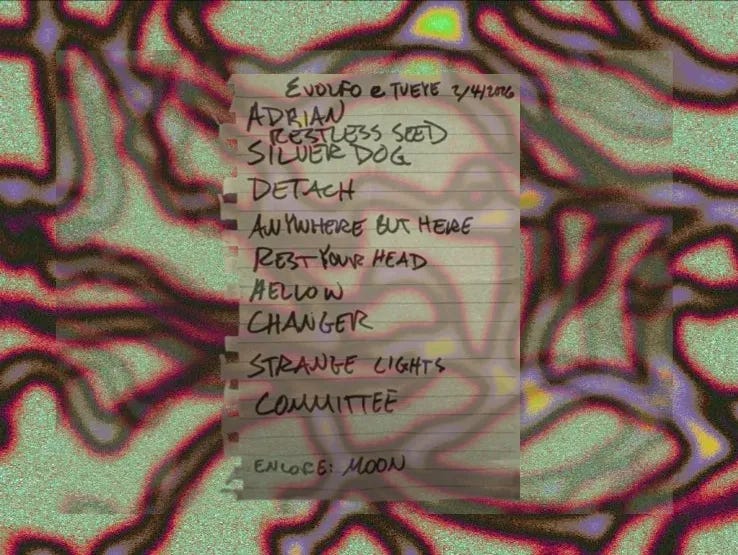
I saw you guys perform some of these songs at TV Eye recently, so it’s clear you can create some wild sounds on stage. But in the recording sessions, how much of those psychedelic sound modifications happened live versus in production?
Ben: More live than not.
Matt: If you hear a well-defined guitar part on the record that’s gonna be an overdub. But there’s this beautiful atmospheric chimey guitar sound overlaying the whole record that I’d liken to the natural sound of the room.
Rafferty: Those guitar parts usually exist in those spontaneous live recordings, but we wanted to bring out certain textures more, so it’s almost more of an experiment in layering and making use of the stereo space.
Compared to other bands playing psychedelic music today, how complex do you get with distorting sounds on stage?
Ben: Probably less than other psychedelic bands. None of us use crazy pedal boards or anything.
Rafferty: Other than Jared. As far as saxophone players go there’s only a few in the world who are doing what he does with pedals and live sampling.
The first psychedelic records dropped sixty years ago. How do you balance vintage psychedelic sounds with modern times?
Matt: One of my favorite soap boxes is about psychedelia in general. I love old psychedelic music but don’t believe that the sounds tied to the genre are the psychedelic part of it; I think it’s more about the opportunity to expand and explore lyrically, sonically, and in the work ethic. What unites psychedelic bands through the eras is that spirit of experimentation and the inner searching. It’s not just phasers and tom-toms, you’ve got to be doing some internal work to make psychedelic music. I understand that palette of sounds helps people identify psychedelic music, but we only draw on that to the extent that it suits our creative journeys.
What does having a “psychedelic work ethic” look like?
Matt: Raff describing the process of making this album sums it up. We’re not putting what we make together into boxes or an eight-hour chunk at a fancy studio. We’re making amorphous blobs of jam and hang time.
I wrote a note down last night, while I was stoned, that these new songs “are about the process of processing.” The record seems like it’s founded on highly attuned observations from perspectives dropped into the middle of an unresolved story.
Ben: Neat!
Rafferty: I’m stoked you picked up on that. As we’ve become more ourselves and developed a voice as a group, I’m way more interested in trying to represent the current moment in any way we can compared to using the established rubrics of a genre. I hope that comes across in the sonic palette and lyrics we’re presenting. We’re a band in 2026, so what does that mean? The bands from 60 years ago were just being themselves and presenting what was fresh and new to them. But loud distorted guitar music is not all we have to play with. The fuzz, the phaser — that’s psychedelic, but so is autotune. Or synthesizers, which can be so much more psychedelic than a guitar could ever be. I’m absolutely not interested in pretending to be from another time.
Matt: There’s a “Psych” section in the record store — we all know what that means sound-wise. I think our music totally fits into that section a lot of the time, but that’s not our guiding light.
What is your guiding light?
Ben: I think it’s about our relationships. Getting closer over the years and dealing with our personal shit. Something in my life might be preventing me from being creative and we’ll figure that kind of thing out together.
I find a lot of your lyrics on the new record to be visceral and hyper-focused on atmosphere and emotion. Do you think hyper-focusing is a technique you guys use to break through creative walls?
Ben: As far as the songs, I feel like they’re all their own little world with their own little needs. You can’t apply one song’s needs to another. Each song is a new thought, and you’re sitting with a new feeling that you need to open your heart up to — I feel like was the general practice. As far as hyper-focusing, though, I don’t think I can hyper-focus on anything.
Rafferty: I’m a firm believer that’s there are unlimited ways to express the same sentiment in a song. For us, it’s about trying to figure out how to say something through imagery or description or some kind of action that communicates what we feel the song is about without offering one singular meaning. We want the listener to connect through their own lens in a way that’s emotionally meaningful to them.
Ben: Yeah, the hyper-focused lyricism may just be a result of purposeful ambiguity.
Rafferty: I’m much more interested in hearing how people interpret our lyrics than telling them what the record means to us. I want our music to resonate with other people in different ways. A more universal way.
What do you guys think about “timeless” music?
Rafferty: That’s the goal. That’s why we all do it. The hope that we make something that can stand the test of time.
Matt: I think timeless songs stem from going deeper and getting closer to something we all share. Not everyone’s going to know what it feels like to experience grief the way you did, but if you can get to the root of that emotion inside yourself, that’s your best shot at making someone else connect.
Rafferty: And not trying to consciously make something timeless — it’s the dream, but that can’t be the North Star.
Ben: I think timeless songs come from artists who are most themselves. I don’t think that’s something you can actually control.
It sounds like setting up a personal space was an important step in the quest for making timeless music, or at least being your true selves while recording.
Ben: For us it was.
Matt: It’s us alchemizing our intentions into the world, taking the spirit of what we want to do and making a space for it.
Rafferty: Between 2015 and 2020, we were probably in five different rehearsal spaces. Grimy spots. Old barns etc. This space changed all that.
How important is song order for an Evolfo record?
Rafferty: Hugely important. We had more than 30 songs recorded for this record, so as a sociological experiment I wanted everyone in the band to sequence their own record out of all the songs. All seven of us met up and everyone presented their preferred sequence of the album and explained why they did it. From there, I noted the overlapping songs and placements and we went from there until the three of us made a final sequence.
Did you consider defining two sides of a vinyl record?
Rafferty: Definitely. On top of the overall puzzle, we needed to think about the timing limitations of pressing a record to vinyl and where the song flow breaks. Not to get too technical, but the songs that are closer to the center of a vinyl record have a different bass response. In the end, we really set our mastering engineer JJ up for a hard time.
Do you guys picture people listening to the record? And if so, what is the ideal setting?
Matt: It’s not background music. I think a focused listen is the way. You could paint while you listen, that’s what I like to do: watercoloring. Maybe occupy your hands and listen. I’m a known fidgeter.
Rafferty: I just imagine someone playing the record on vinyl, or a deep headphone listen like you did.
Ben: I haven’t thought about it at all.
Rafferty: Yeah, however someone listens — off the phone, whatever — that’s cool. I’d also recommend driving. We definitely did some road tests.
Psychedelic music is historically tied to drug culture, substance experimentation, mind expansion. Is that a part of the communal process for you guys?
Rafferty: We’ve definitely done that for sure, but not as much in relation to the creative aspects. It’s not like we’re all tripping while recording the record.
Ben: Yeah that sounds difficult. I think we’ve all just used our experiences as a basis for our creative mindsets in general.
Matt: The psychedelics have had a direct influence upon the writing, but only in as much as they’ve taught me about myself and caused me to go deep. I think what we have as a band that’s unique is that we’re open with each other. We do the downloads of our psychedelic trips, we discuss those experiences together.
Earlier, Ben mentioned confronting tough subject matter as a group. And there’s songs on here about grief. One lyric I can’t let go of asks, “How does grief release?” How do you guys move through difficult topics like these?
Rafferty: We’ve gone through a lot of stuff together. Sometimes we don’t even need to say it outright. It’s already felt.
Ben: We’ve had so many years of divulging our deepest darkest shit in a van. And, it’s funny, I feel like the theme of this interview is that this record is a reflection of our lives and how we’ve grown and changed together over the years.
And how you’ve created an atmosphere to create.
Ben: Just a bunch of smelly boys.
Matt: A gaggle of friends. And I feel proud of how we’ve stuck with it. Sometimes when I’m feeling self-deprecating, I’m embarrassed to have been playing TV Eye for ten years. But the wiser part of me is so grateful to have a group of friends that create together. It takes effort and intention. We’ve kept it going against all odds and it’s something to be proud of.
Rafferty: I’m conscious of how trying to deepen our connection as musicians and bandmates and humans is not always how it goes. Over the past ten years, we could have worked on refining a more efficient process in writing hit songs. We could have done that instead. So I think it’s cool that we’ve made a conscious effort to create a space like this where we created a record born out of wanting to deepen our connection as improvisers.
What would you say your most surprising musical influence would be for someone listening to Evolfo for the first time?
Matt: Can I claim Ween?
I’ve been Weening out pretty hard this year myself.
Matt: There was a pretty profound The Mollusk influence this year.
Ben: Just a scraggly conch shell on the beach, it kept coming up. But I have an influence: Aphex Twin. It’s really beautiful and then it gets really scary out of nowhere.
Rafferty: Oh dude, I’ve got so many surprises. I’ve been super into K-Pop lately, listening to the new BTS album.
What do you appreciate about K-Pop?
Rafferty: It’s just the best pop music money can buy. It’s like if someone took the fucking Backstreet Boys and made them into Powerpuff Girl superheroes. It’s like ear candy. When they hit the mark it’s the best pop music out right now.
If you Evolfo was invited be on a tribute compilation, like Day of the Dead, what band would it be and what cover would you contribute?
Rafferty: Maybe Velvet Underground?
What song?
Rafferty: “Venus in Furs” would be sick. It’d be a good one for us to do our own way. I was thinking about The Stooges, or CAN, but we’re almost too close to their sound. With the Velvets we could do a droney thing in our style. The Dead would also be sick for the same reason.
It’s a thinker.
Rafferty: I would also love to do a country thing. My favorite tribute album ever might actually be the Townes Van Zandt record. It’s fun to hear how people interpret his songs. Or Lucinda Williams.
Ben: Maybe like a George Jones situation.
When was the first time you were each taken by psychedelic music?
Matt: It had to be Pink Floyd. One of the first records I ever got into was Dark Side of the Moon but the one that made me want to make psychedelic music was The Piper at the Gates of Dawn, their first album.
Rafferty: Mine’s definitely Jimi. In 6th grade I discovered Jimi Hendrix and it changed my life entirely. I found my dad’s CDs and just remember putting Axis: Bold As Love in the CD player and the alien talking at the beginning of the record…I was like “What the hell is this?”
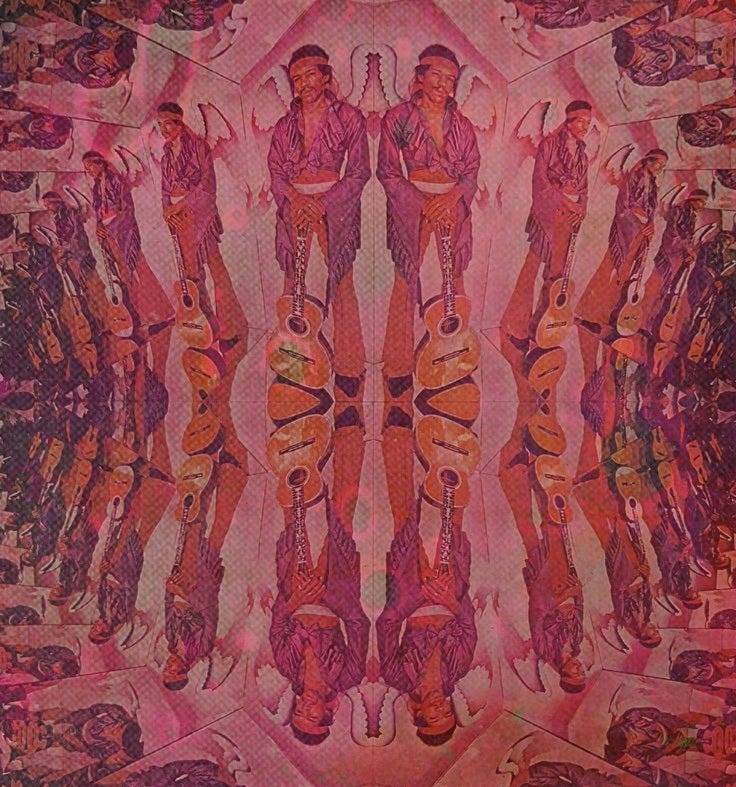
Just like your song, “The Committee.”
Rafferty: Yeah, and just how he used the studio: next level. To this day, there are sounds on that record I just don’t understand. There’s mystery in that record for me. Which is insane. For how seminal of an album it is, there’s still uncharted waters. This convergence of a man who is one with his guitar, becoming able to express that in this way that’s still unparalleled.
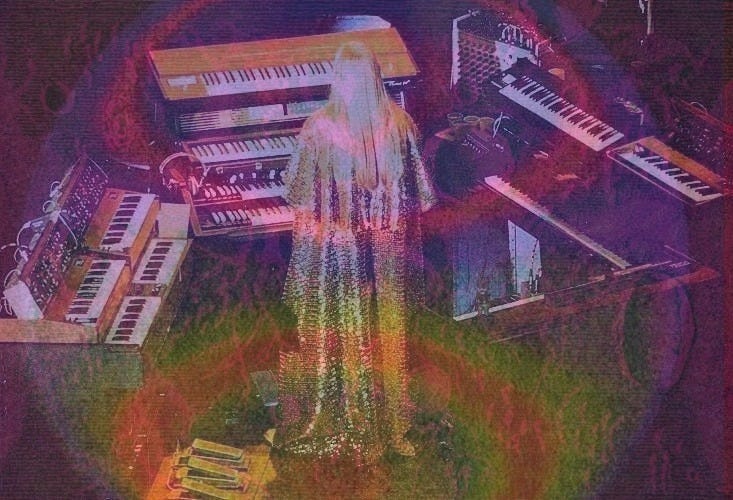
Ben: For me, it’s probably Close To The Edge by Yes. It’s so composed, and episodic yet feels free. Also a concept album, about Siddhartha.
Rafferty: I’m stoked I’m not the one who shouted out Yes.
Ben: As the organ man?
Rafferty: Yeah. I almost let it slip earlier in this interview, but I held back.
What about current psych bands playing today. Who would you love to share a bill with?
Rafferty: Anyone from Kikagaku Moyo. Any of the offshoot solo projects on the Guruguru Brain label. Like Minami Deutsch, a Japanese kraut-rock-style band. They’re making my favorite kind of contemporary shit happening right now.
Matt: I would love to play with Thee Oh Sees. Or White Fence. That’s where my heart is. Pretty straight-forward answer for someone in the psych corner. But of course there’s a lot of other bands.
Is there a festival you guys have your sights set on?
Matt: Desert Days is kind of the one. But also Levitation or Austin Psych Fest would be cool.
Ben: The Catalina Psych Mixer.
Rafferty: Been there done that! Catalina Island is a weird place.
I’ve only seen it in a film.
Rafferty: Step Brothers?
Yup.
Ben: I’d love to play with Deerhoof. They’re not really a psychedelic band but they’re like art-rock. They’re so organic. Their live show is crazy, the tempos are changing all over the songs, they’ll stop in the middle of a chorus and do a weird drum solo and go right back. It’s so funky.
Matt: Evolfo and Deerhoof would total make sense together. They’re so unconstrained, they don’t operate within a single genre.
Back to Guruguru Brain, are they an inspiration for your own record label, Food Of Love Records?
Rafferty: Absolutely. The way they run their label is a definite inspiration. It’s very art-forward and prioritizes physical media; it’s just clear that they’re trying to cultivate a community. Every artist they sign is either a member of Kikagaku Moyo or someone they know from Japan/East Asia. The limited releases they do are also very cool.
Matt: Yeah, the focus on physical media is huge. Like why phone in that part of the process? I’m learning it’s a whole fuck shitload of effort to put out something with that much quality and care, but I really do care about it. It’s so special to make something you actually want to hold in your hands. That’s our top priority.
All of the bands I’ve been gravitating to for Jam Jar features — Misha Panfilov, Nudie Records etc. — seem to appreciate physical media. Even with Sturgill Simpson’s recent Johnny Blue Skies release, I feel like physical media is widely valued right now.
Rafferty: I think as people become more disillusioned by how much our world is online, they appreciate records. And the record industry has become more decentralized, more localized, more regionalized. Small labels can represent a whole scene or community. For a while, people tried to emulate major labels, but you don’t need to do that anymore; it doesn’t really work in the age of streaming. We’re going back to a more hands-on approach. As an artist, everything you can control, you should control yourself. People really respond to that.
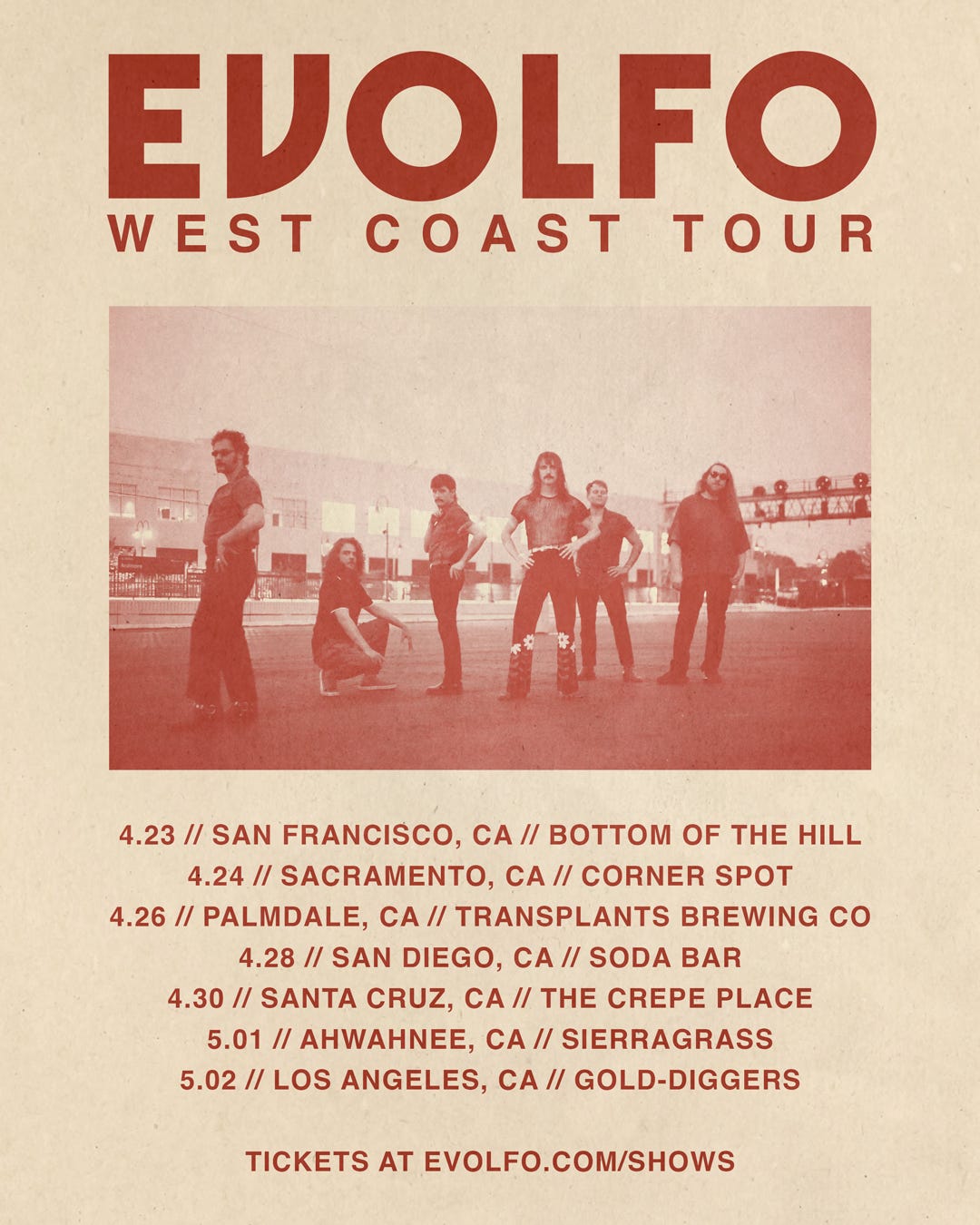
Check out Evolfo’s upcoming shows: